
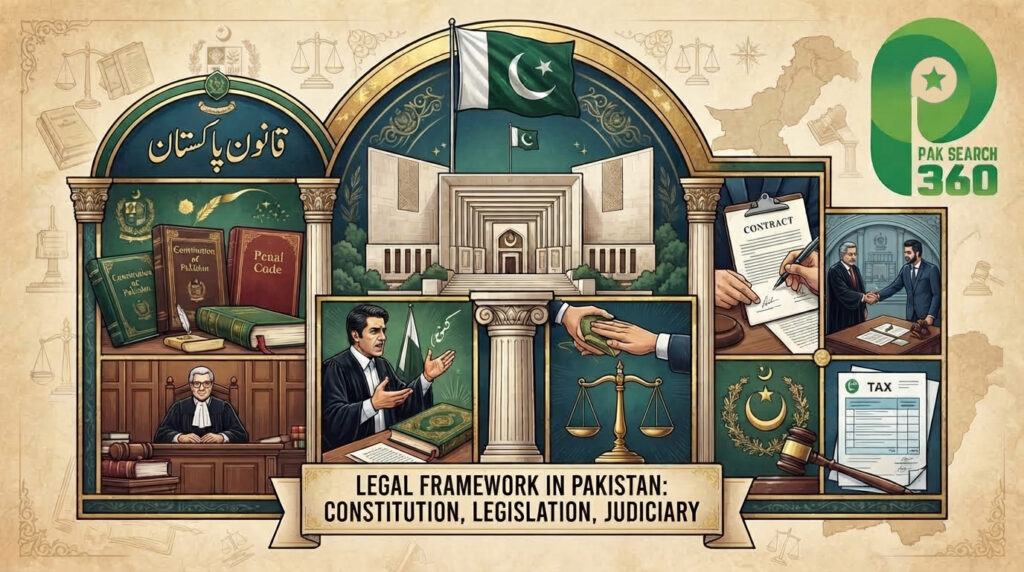
Every country needs rules and a way to enforce them. In Pakistan, this system is called the legal framework, and it rests on one key document: the Constitution of 1973. On top of that, Pakistan runs a set of courts and written laws that protect people’s rights and keep order. Pakistan’s legal system is a mix of two traditions. It uses British-style law from colonial times, and it also follows Islamic principles, since the Constitution requires this. This page explains how all these pieces fit together.
Legal Framework of Pakistan at a Glance
| Part of the System | What It Does |
|---|---|
| Constitution (1973) | The supreme law — every other law must follow it |
| Supreme Court | The highest court; has the final say |
| High Courts | One in each province, plus Islamabad |
| District & Sessions Courts | Handle most everyday cases |
| Federal Shariat Court | Checks that laws follow Islamic principles |
| Pakistani Laws | Covers crime, business, and family matters |
| NAB & Ombudsman | Hold officials and departments accountable |
What Is the Legal Framework of Pakistan?
Think of the legal framework of Pakistan as three parts working together. First, the Constitution sets the basic rules for the whole country. Second, courts apply and explain those rules when there’s a dispute. Third, written laws tell people exactly what they can and can’t do. If a law breaks a rule in the Constitution, a court can cancel that law. This check keeps the whole system fair and balanced.
The Constitution: Pakistan’s Top Law
Pakistan adopted its Constitution on August 14, 1973. It’s the highest law in the country, so no other law, rule, or government action can go against it. The Constitution also protects basic rights for every citizen, like equal treatment under the law and freedom of movement. Parliament has changed the Constitution more than 20 times since 1973. One of the biggest changes, the 18th Amendment in 2010, gave provinces more control over things like health and education. You can download the full Constitution here.
Pakistan’s Court System Explained
Courts in the legal framework of Pakistan work like a ladder — each level handles bigger or more specific cases than the one below it.
- Supreme Court of Pakistan — the top court. Its decisions are final, and every other court must follow them. You can check live case updates on the Supreme Court’s official website.
- High Courts — one for each province (Punjab, Sindh, KP, Balochistan) plus one for Islamabad. They handle serious appeals.
- District and Sessions Courts — the first stop for most cases, like property disputes or criminal charges.
- Federal Shariat Court — checks whether laws follow Islamic principles.
- Special Courts — extra courts just for family matters, terrorism cases, or labor disputes.
A case can start small, in a District Court, and move all the way up to the Supreme Court if it’s important enough.
Why the Legal Framework of Pakistan Matters to You
You don’t need to be a lawyer to benefit from understanding this system. If you know which court handles your type of case, you won’t waste time filing in the wrong place. If you know your rights under the Constitution, you can speak up when they’re ignored. And if you know where to find the actual law, you won’t have to rely on rumors. If you’re also curious how Pakistan’s political system connects to its legal one, that’s covered in depth on our Political Framework page. That’s why PakSearch360 breaks all of this down in plain language.l the way up to the Supreme Court if it’s important enough.
Pakistani Laws You Should Know
Pakistan’s legal system runs on a set of written laws, not just the Constitution. Criminal cases follow the Pakistan Penal Code, a law from 1860 that’s been updated many times. Civil disputes, like arguments over property, follow a separate law called the Code of Civil Procedure. Family matters — like divorce or child custody — have their own laws too. Business and tax rules make up yet another set of laws. Our Pakistani Laws page sorts all of these by category, so you can find the exact law you need.
Who Holds Officials Accountable?
A fair legal system needs a way to catch officials who break the rules. Pakistan uses two main institutions for this. The National Accountability Bureau (NAB) investigates corruption by government officials. The Federal Ombudsman lets regular citizens complain about government departments — without needing a lawyer or going to court. We’re building full pages on both. Check back soon.
Why the Legal Framework of Pakistan Matters to You
You don’t need to be a lawyer to benefit from understanding this system. If you know which court handles your type of case, you won’t waste time filing in the wrong place. If you know your rights under the Constitution, you can speak up when they’re ignored. And if you know where to find the actual law, you won’t have to rely on rumors. That’s why PakSearch360 breaks this down in plain language.
Frequently Asked Questions
What is the highest court in Pakistan?
The Supreme Court of Pakistan is the highest court. Its decisions are final, and every other court must follow them.
How many High Courts does Pakistan have?
Pakistan has five High Courts — one each for Punjab, Sindh, Khyber Pakhtunkhwa, and Balochistan, plus one for Islamabad.
What is the Federal Shariat Court?
It’s a special court that checks whether Pakistani laws follow Islamic principles. You can appeal its decisions to the Supreme Court.
Is Pakistan a common law or Islamic law country?
Both. Pakistan’s court system comes from British common law, but the Constitution also requires all laws to follow Islamic principles.
What’s the difference between NAB and the Ombudsman?
NAB investigates corruption and can lead to criminal trials. The Ombudsman handles complaints about poor service from government departments, usually without going to court.